Máy đúc dầm chữ T bê tông dự ứng lực: Hướng dẫn toàn diện về máy đúc dầm chữ T bê tông dự ứng lực
In residential and commercial construction across the world, the beam-and-block flooring system has become one of the most efficient and economical methods for building floors and roofs. At the heart of this system sits the concrete T beam — a prestressed structural joist that spans between walls to support infill blocks or hollow core slabs above. Producing these beams quickly, consistently, and at scale requires a dedicated prestressed concrete T beam machine.
Whether you’re setting up a new precast concrete factory or expanding an existing production line, a prestressed T-beam forming machine using slip-form extrusion technology delivers a production capacity four to five times greater than traditional mould-based methods — with better surface finish, higher density, and far lower labor requirements.
This guide covers everything you need to know: what a concrete T beam is, how the machine works, its key advantages, the supporting equipment required, customization options, and how to choose the right system for your production needs.
What Is a Prestressed Concrete T Beam?
A prestressed concrete T beam — also known as a roofing floor beam, joist beam, or concrete joist — is a slender, T-shaped precast concrete structural element used primarily to support hollow core infill blocks or slabs in floor and roof construction.
The cross-sectional shape resembles the letter “T”: a narrow vertical web at the bottom that provides bending depth, and a wider horizontal flange at the top that sits on the supporting wall and bears the load of the infill blocks laid across it. This shape is structurally efficient — it concentrates material where it is most needed for bending resistance, keeping the beam lightweight without sacrificing structural performance.
What makes the beam truly high-performance is the prestressed steel wire reinforcement running through its length. By pre-tensioning carbon or high-tensile steel wires before casting, the concrete is placed in a state of pre-compression. This dramatically increases the beam’s ability to carry loads without cracking, and allows longer spans with a shallower beam depth than ordinary reinforced concrete would permit.
Cái prestressed concrete T beam machine is the equipment that manufactures these beams continuously, precisely, and efficiently.
What Is a Prestressed Concrete T Beam Machine?
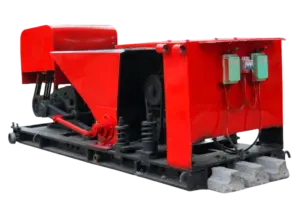
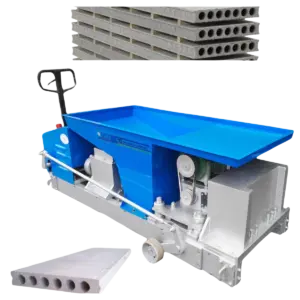
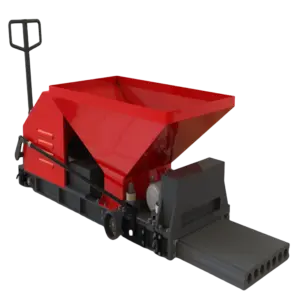
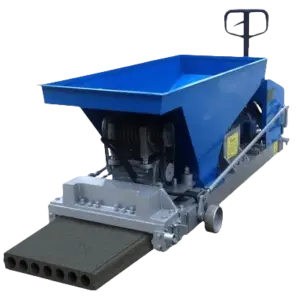
A prestressed concrete T beam machine — also called a concrete joist machine or prestressed T-beam forming machine — is a slip-form extrusion machine that continuously produces prestressed concrete T beams or joists along a pre-tensioned casting bed, without the need for individual moulds or formwork for each beam.
The machine operates on the same fundamental principle as a hollow core slab extruder or wall panel extruder: concrete is fed into the machine’s hopper, and the machine moves along the casting bed, compacting and shaping the concrete around pre-tensioned steel wires into the T-beam profile as it advances. The result is a continuous run of T beams with a smooth, dense surface finish that requires no mould stripping, cleaning, or reassembly between production cycles.
Custom-sized T-beam profiles can be designed and manufactured to meet different span and load requirements. The machine can be configured to cast anywhere from 2 to 8 rows of T beams simultaneously in a single pass, depending on beam size and casting bed width — making it one of the highest-output beams production methods available.
How the Prestressed T-Beam Forming Machine Works
The production process with a prestressed T-beam forming machine follows a structured sequence:
Step 1 — Steel Wire Pre-Tensioning
High-tensile steel wires are threaded along the full length of the casting bed and tensioned to the specified prestress level using a steel wire tensioning machine (either a screw-rod type or a hydraulic jack type, depending on the wire specification). The wires are anchored at both ends of the bed and held under tension throughout the casting and curing process.
Step 2 — Concrete Preparation
A concrete mixer — typically a pan mixer or forced twin-shaft mixer — prepares a dry or semi-dry concrete mix with the consistency required for slip-form extrusion. For one or two T-beam machines, a 450-litre pan mixer provides sufficient output to maintain continuous production.
Step 3 — Concrete Feeding
A battery-powered concrete feeding dumper with an integrated belt conveyor system collects fresh concrete from the mixer and delivers it rapidly and continuously to the T-beam forming machine along the casting bed. This automated feeding arrangement eliminates manual concrete handling and ensures a steady supply to the machine.
Step 4 — Slip-Form Extrusion
Cái prestressed concrete T beam machine travels along the casting bed, receiving concrete from the feeding dumper into its hopper. Internal augers and compaction mechanisms compact the concrete around the pre-tensioned steel wires and form it into the T-beam cross-section profile as the machine advances. The slip-form principle means the freshly cast beam holds its shape immediately behind the machine without any external formwork support.
Step 5 — Curing
The cast T beams cure on the casting bed — either by natural air curing or accelerated steam curing for faster turnaround. The wires remain under tension throughout the curing period to ensure the prestress is properly developed in the concrete.
Step 6 — Cutting to Length
Once the concrete has reached sufficient strength, an automatic concrete cutting machine fitted with a diamond saw blade (400 mm or 500 mm diameter) cuts the continuous beam run into individual T beams of the required lengths specified by the construction project.
Step 7 — Prestress Transfer and Demoulding
The wire tension at the ends of the casting bed is released. The elastic rebound of the wires transfers compressive prestress into each cut beam segment through the bond between wire and concrete. The finished T beams are then lifted from the bed and stored for delivery or immediate use.
Key Advantages of the Prestressed Concrete T Beam Machine
Switching from traditional mould-based T beam production to a prestressed T-beam forming machine delivers significant operational and commercial advantages:
4–5× Higher Production Efficiency
Compared to traditional mould-based production methods, the slip-form extrusion approach delivers four to five times the output per shift. There is no time lost to mould assembly, mould stripping, cleaning, or reassembly between production cycles. The casting bed is simply retensioned and the machine makes another pass.
Minimal Labor Requirement
Only two to three persons are needed to operate an entire precast T beam factory — one managing the concrete mixing and feeding, one operating the T beam machine, and one managing the cutting and yard operations. This dramatically reduces labor costs compared to mould-based production, which requires significantly larger crews for formwork handling.
Multi-Row Simultaneous Casting
A single machine can cast 2 to 8 rows of T beams simultaneously in one pass, depending on beam size. This multiplies the effective output of each casting run and maximizes the productivity of every meter of casting bed length.
Flexible Length Cutting
Beams can be cut to any length required by the construction project using the concrete cutting machine. There is no fixed mould length to work around — the continuous casting process makes the beam length a simple cutting decision rather than a manufacturing constraint.
Superior Product Quality
T beams produced by slip-form extrusion have a smooth, dense surface finish and a highly compact internal structure. The consistent compaction delivered by the machine surpasses what is achievable by hand-filling individual moulds, resulting in stronger, more uniform products with better durability.
Multi-Layer Wire Reinforcement
Cái prestressed concrete T beam machine supports the placement of up to three layers of prestressed steel wires inside each beam. The total prestressing force can be customized to match the span length and load requirements of specific construction projects.
Custom Beam Sizes on Request
The machine can be designed and configured to produce T beams in different cross-sectional sizes, accommodating the varying floor depths and load requirements of different construction markets and project types.
Long Service Life, Low Maintenance
The slip-form extrusion machine has a robust design with few wear-intensive moving parts relative to its output capacity. With routine maintenance, it delivers a long working life without the high ongoing costs associated with maintaining large inventories of steel moulds.
The Beam-and-Block Flooring System: Why T Beams Are in Growing Demand
Cái prestressed concrete T beam machine sits at the center of one of the fastest-growing flooring systems in residential construction — the beam-and-block (or beam-and-pot) floor system.
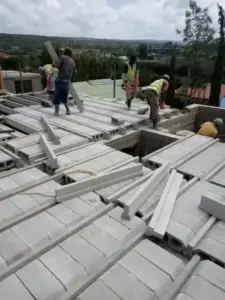
In this system, prestressed T beams are laid at regular spacings between supporting walls. Concrete infill blocks — either solid blocks, hollow blocks, or EPS polystyrene void formers — are placed between and over the beams to fill the span. A thin structural screed or topping is then applied to complete the floor or roof.
The beam-and-block system has grown rapidly in popularity for several reasons:
Speed of construction — The beams and blocks arrive on-site pre-manufactured. No in-situ formwork or propping is required below the floor during construction, which significantly accelerates the build program.
Material efficiency — The infill blocks reduce the volume of concrete required compared to a solid in-situ slab, lowering material costs and the self-weight of the floor.
Thermal and acoustic performance — The air voids created by the infill blocks improve the thermal insulation and sound attenuation of the floor system compared to a solid concrete slab.
Accessibility for small contractors — Precast T beams can be handled manually on smaller projects, requiring no crane for typical residential spans. This makes the system accessible to small builders and self-builders in markets where crane hire is expensive or impractical.
Supplying both the prestressed T-beam forming machine and the complementary infill block machine allows a precast manufacturer to serve the complete beam-and-block flooring system market from a single production facility.
Supporting Equipment for a Complete T Beam Production Line
A prestressed concrete T beam machine does not operate in isolation. A fully functional production line requires a coordinated set of supporting machines:
Concrete Mixer
A pan mixer or forced twin-shaft mixer prepares the concrete mix for the T beam machine. For a single T-beam machine, a 450-litre pan mixer is typically sufficient. Larger production lines with multiple machines require proportionally larger mixing capacity.
Battery-Powered Concrete Feeding Dumper
Equipped with an integrated belt conveyor, the battery-powered dumper collects fresh concrete from the mixer and transports it efficiently to the T-beam machine along the casting bed. Battery power eliminates exhaust fumes and enables use in enclosed production environments. The belt conveyor ensures a continuous, controlled feed into the machine’s hopper.
Steel Wire Tensioning Machine
Two options are available depending on the wire specification:
Screw-Rod Type Tensioning Machine — A mechanically simpler option suited to lower-strength wire specifications and smaller-scale production. The screw rod is turned to apply and measure the tensile force.
Hydraulic Jack Type Prestressing Machine — The preferred option for higher-strength wire specifications and larger production volumes. The hydraulic jack delivers precise, repeatable tensile force control and accommodates a wider range of wire diameters from 3 mm to 15 mm.
Concrete Cutting Machine
After curing, the continuous T beam run must be cut into individual beams of the required lengths. The cutting machine is fitted with a diamond saw blade — 400 mm or 500 mm in diameter — and uses high-speed rotational cutting to produce clean, precise cuts through cured reinforced concrete. The cutting length is set to match the span requirements of the construction project.
Infill Block Machine (Optional but Recommended)
For manufacturers wishing to supply the complete beam-and-block flooring system, a complementary concrete block machine produces the infill blocks that fill the spaces between T beams. Offering both T beams and infill blocks from a single production facility maximizes market coverage and customer value.
Customization: Designing the Right T Beam Size for Your Market
One of the key strengths of a purpose-built prestressed concrete T beam machine is the ability to customize the machine to produce the exact T beam cross-section required for your target construction market.
Different markets use different beam depths, flange widths, and web thicknesses depending on local construction practices, floor span requirements, and load standards. The machine manufacturer’s engineering team can design a machine profile to match these requirements, ensuring that the T beams produced are directly compatible with the infill block sizes and floor system specifications used locally.
Custom design considerations include:
Beam depth (web height) — Determines the structural span capability of the beam. Deeper beams can span further or carry heavier loads.
Flange width — The width of the top horizontal flange affects how the beam bears on the supporting wall and how the infill blocks sit on it.
Web thickness — Affects the weight and strength of the beam in the transverse direction.
Number of wire layers — From one to three layers of prestressed wire, matched to the required prestressing force for the target span and load.
Number of simultaneous rows — From 2 to 8 rows per pass, matched to the casting bed width and target production volume.
Applications: Where Are Prestressed T Beams Used?
T beams produced by a prestressed T-beam forming machine are used across a wide range of construction types:
Residential Floor and Roof Construction — The primary application. Beam-and-block floors are widely used in low-rise and medium-rise housing, particularly in markets where precast construction is favored for its speed, affordability, and accessibility to smaller contractors.
Agricultural Buildings — Farm buildings, storage facilities, and livestock housing frequently use T beam and block floors for their durability and ease of construction.
Commercial and Industrial Light Construction — Single-story commercial units, workshops, and warehouses use T beam floors for economical, fast-track construction.
Low-Cost Housing Programs — Government and NGO-led affordable housing projects in developing economies rely heavily on beam-and-block systems for their low material cost, minimal equipment requirements, and fast construction pace.
Schools and Community Buildings — Institutional buildings in markets with strong precast construction traditions use T beam and block systems for classrooms, community halls, and similar structures.
How to Choose the Right Prestressed Concrete T Beam Machine
When evaluating a prestressed T-beam forming machine for your production facility, consider the following selection factors:
Target Beam Size and Profile Define the T beam cross-section required for your market before approaching a manufacturer. The machine must be designed around the specific beam profile — this is not a one-size-fits-all product.
Number of Simultaneous Rows Higher row counts per pass increase output per casting cycle but require a wider casting bed and more concrete supply capacity. Match the machine configuration to your planned production volume and casting bed dimensions.
Wire Specification and Tensioning System Confirm the diameter and tensile strength of the prestressing wire you intend to use, and select the appropriate tensioning machine type (screw-rod or hydraulic jack) accordingly.
Casting Bed Length Longer casting beds produce more beams per cycle and allow longer individual beam lengths. Balance casting bed investment against your planned beam length range and site available.
Cutting Machine Compatibility Ensure the concrete cutting machine supplied is configured with the correct blade diameter and cutting capacity for your beam dimensions and concrete strength.
Infill Block System Compatibility If you plan to supply the complete beam-and-block system, confirm that the infill block machine produces blocks compatible with the T beam dimensions your machine will produce.
After-Sales Engineering Support Because the T beam machine is custom-designed to your beam profile, after-sales engineering support is important for commissioning, operator training, and any profile adjustments required after initial production trials.
Câu hỏi thường gặp
Q: How many T beams can the machine produce per day? A: Output depends on the casting bed length, number of rows per pass, curing time, and beam length. A single machine casting 4–6 rows on a 60–100 m bed can produce several hundred linear meters of T beam per day — four to five times the output of equivalent mould-based production.
Q: Can the machine produce T beams of different lengths on the same casting run? A: Yes. The continuous extrusion process produces a single run along the full casting bed length. The concrete cutting machine then cuts individual beams to any required length from the cured run, so multiple different lengths can be cut from the same casting cycle.
Q: How many steel wire layers can be placed inside each T beam? A: The machine supports up to three layers of prestressed steel wires per beam. The number of layers and wire diameter are selected based on the required prestressing force, which is determined by the design span and load of the beam.
Q: What is the minimum team size needed to operate a T beam production line? A: A complete T beam production line — including concrete mixing, feeding, extrusion, and cutting — can be operated by two to three persons, making it highly labor-efficient for a small or medium precast manufacturer.
Q: Can I also produce concrete lintels or other elements on the same machine? A: The T-beam machine is a purpose-designed profile machine. While some manufacturers offer multi-profile machines or interchangeable forming heads, you should confirm with the manufacturer what other element types, if any, can be produced on the same equipment.
Kết luận
A prestressed concrete T beam machine is a high-productivity, low-labor solution for manufacturing the prestressed joists that underpin one of the most widely used floor and roof construction systems in the world. By combining the slip-form extrusion principle with prestressed steel wire reinforcement and a fully integrated supporting equipment line, the prestressed T-beam forming machine delivers superior output efficiency, consistent product quality, and the flexibility to serve a wide range of construction markets.
Whether you’re entering the precast T beam market for the first time or scaling up an existing operation, investing in a purpose-built, custom-designed T beam extrusion machine — supported by the right mixing, tensioning, feeding, and cutting equipment — positions your factory for productive, profitable, and sustainable precast manufacturing.
For custom T beam machine designs, full production line specifications, and pricing, visit Công ty TNHH Thiết bị Máy móc KZONG Trịnh Châu.